#120 – Matching Decisions to Reality

I have recently completed a short, 1 hour introductory resilience course: Personal and Organizational Resilience on Hive Mind website [1].
The course defines resilience narrowly as resilience to shocks. In the broader definition, it is just one of four resilience capabilities, understood as the ability of a system to return to normal after experiencing disruption.
One idea I found particularly stimulating was the Cynefin framework. Cynefin sounds like the name of a fintech startup, but it is actually a Welsh word meaning “place of your multiple belongings.”
Developed in the late 1990s by Dave Snowden at IBM, Cynefin is a decision-making framework focused on uncertainty and crisis. That makes it especially relevant to resilient thinking.
A central insight of the framework is that organisations often fail in crises not because they lack intelligence, but because they apply the wrong logic to the situation. Different environments require fundamentally different responses.
If we cannot correctly identify the type of situation we are facing, we risk falling into what Snowden calls disorder — a dangerous state where decisions no longer match reality. Symptoms of disorder include endless meetings, conflicting expert opinions, overanalysis and false certainty.
The framework divides situations into four domains.
Clear
In clear situations, cause and effect are obvious. Best practices work well, processes can be standardised, and leadership can rely on command-and-control structures.
Examples include routine accounting processes or standard surgical procedures.
Complicated
In complicated situations, cause and effect exist but are not immediately obvious. Expertise and analysis are required to understand the problem.
Examples include aircraft engine failure analysis or large ERP implementations. Experts are valuable here, and leaders should rely on specialist knowledge, consultation and scenario analysis.
Complex
In complex situations, cause and effect can only be understood retrospectively. Outcomes cannot be predicted with confidence in advance.
Pandemic response or geopolitical instability belong largely to this domain. Organisations need safe experimentation, distributed leadership and rapid feedback loops. Adaptation matters more than optimisation.
In this environment, strong opinions are less valuable than the ability to absorb feedback and learn quickly.
Chaotic
In chaotic situations, there is no perceivable relationship between cause and effect. The priority is immediate stabilisation rather than perfect analysis.
Examples include cyberattacks or the outbreak of war. In chaos, waiting for complete information can be fatal. Leaders need to act decisively, almost in a military fashion, to create order, even if the initial response is imperfect. This type of response is often taught in resilience trainings led by former special forces officers.
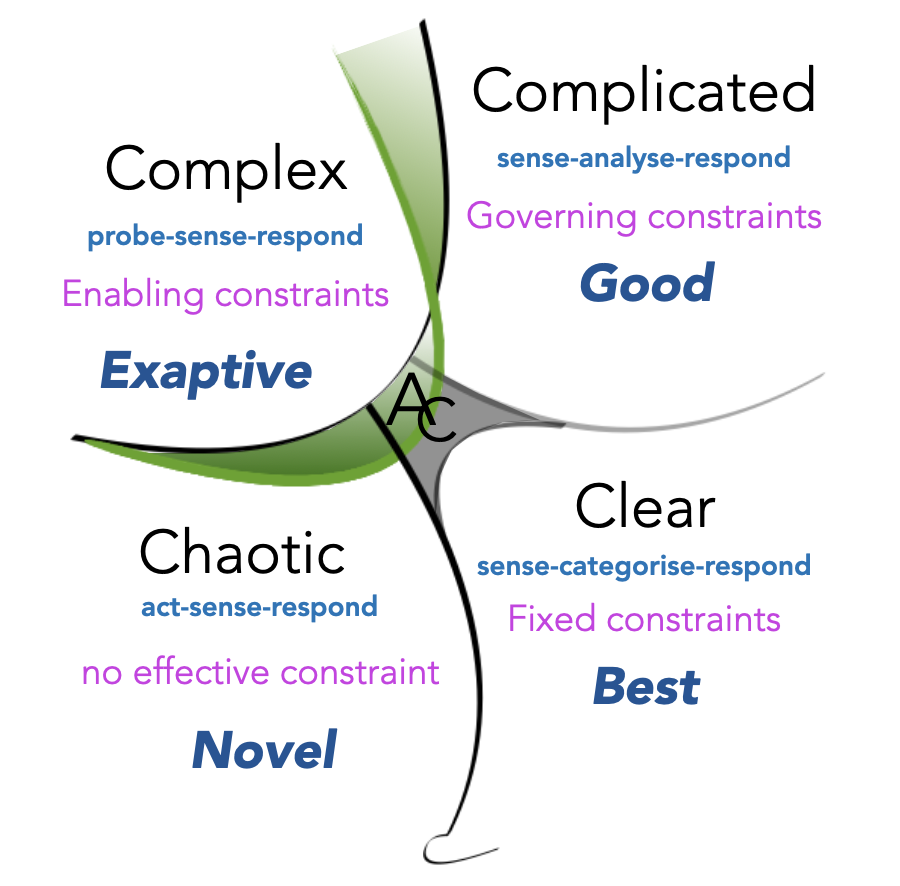
If organisations fail to recognise which domain they are operating in, they can easily drift into disorder, where decisions are not suitable to the situation. One could argue that many governments and organisations experienced exactly this during COVID. Much of the response treated the pandemic as a merely complicated problem: gather experts, analyse the data and produce the correct plan.
But large parts of the crisis were actually complex and chaotic. Information changed rapidly, feedback loops were delayed, and interventions often produced unintended consequences.
COVID was a good example of a situation requiring multiple response types. Framing it primarily as a complicated problem created the impression that the best experts were in control and that uncertainty could be managed through analysis alone. Reality however is often much more uncertain and this false certainty pushes organisation or society into disorder.
In disorder, organisations often respond badly by pretending certainty, centralising everything, suppressing bad news or searching for one master plan.
More resilient responses look very different. They involve framing reality honestly, creating shared sense-making, encouraging signal detection, allowing controlled experimentation and adapting continuously.
In this sense, good decision-making is less about prediction and more about maintaining the ability to face reality and adjust quickly.
Cynefin is therefore a useful framework not only for crisis management, but also for thinking about resilience more broadly. Standardisation, flexibility, expertise and decisive leadership are all valuable — but only in the right context.
Resilient organisations are not the ones with the best plans. They are the ones able to recognise what kind of reality they are facing, and adapt before reality forces them to.
I publish one short reflection like this each week. If you would like to receive them by email, you can sign up to the newsletter here


Comments