#17 Be careful when you feel happy!

Updated: Apr 16, 2024
Valentine’s Day originated as a Christian celebration honoring a martyr named Valentine, and later evolved into a global celebration of romance and love. It feels really good to be in love and happy, those are emotions we all seek. And we should, it is important to have as many good moments as the live brings to us!
There is though always a caveat in all emotional states we have and the state of love, which creates particularly good mood, can be quite a challenge when you are in front of important decision.
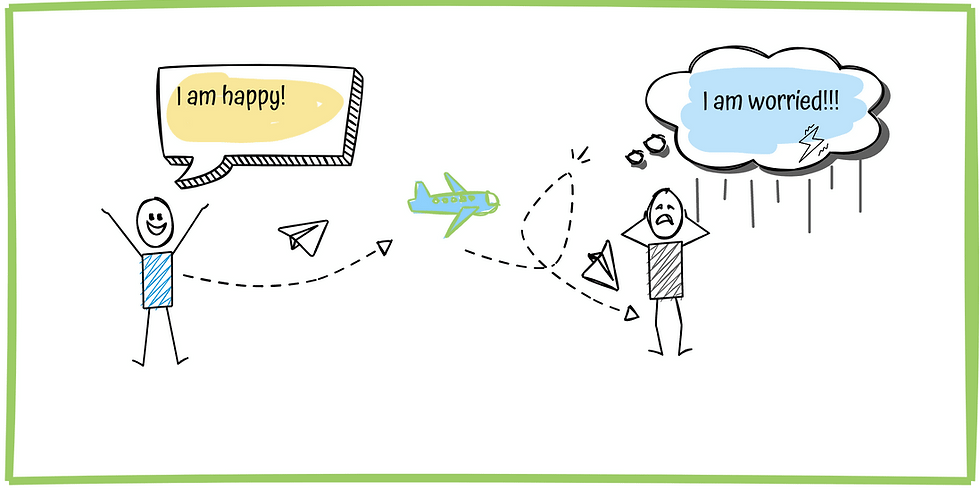
Daniel Kahneman claims that we should be extra careful when we are in a good mood, because our logical, analytical part of the brain is then weaker. A happy mood loosens the control of this part of the brain over our actions. That makes us more intuitive, creative and at the same time less alert and less logical. A good mood gives a signal to the brain that everything is going well, environment is safe, and there's no immediate need for the heightened alertness that critical decisions often demand. This relaxed state of mind creates smiley, friendly reactions for the events which would otherwise be worrying.
It is important therefore to be able to recognize the impact of emotional state on performance:
When you need to be creative, innovative, and friendly, good mood is the right place to be.
For important decisions, which require risk awareness and logic you would do better if you are in a bad mood.
Balanced mood would be optimal in most situations, but it is very difficult to stay in this zone for longer.
Those insights have profound implications for professionals, especially those in fields like finance, where risk assessment and logical rigor are paramount.
Does that mean that finance professionals should be rather gloomy and generally not too happy as his job is to identify risks, bring numbers, analytical thinking, and logic to the table?
Or maybe the key is in awareness and, if you are a finance guy who is too often in a good mood, you should manage cognitive ease trap and try to be mindful of the impact it has on your critical thinking ability?
At the team level those findings emphasize the need for diversity, a healthy balance of positive and negative thinkers. We need all of them to be creative, innovative, but also logical and aware of risks.
In conclusion emotions we experience, whether they are good or bad, impact our performance. Awareness of those impacts can enhance our ability to understand reality and resilience levels. Be careful when you feel happy and don’t try to be very creative when you feel down.
Sources:
Kahneman D. - Thinking, fast and slow. Farrar, Straus and Giroux, 2011.


Comments