#126 - When Voice Persuades and Reading Clarifies

During last week’s Human–AI Collaboration Summit at Kozminski University, Prof. Richard B. Freeman from Harvard said that perhaps he is old-fashioned, but he prefers to read rather than listen.
Reading, in his view, improves both understanding and our ability to think. Freeman gave the example of the current US President, who conveys considerable emotion in his speeches. Once transcribed and read on paper, however, they make very little sense, if any at all.
Reading does two things at the same time.
First, it removes some of the noise created by the emotions of the voice and images, leaving us closer to the underlying content. We are constantly bombarded with messages designed to trigger emotional reactions and achieve particular objectives—objectives that are not necessarily aligned with our interests, but rather with those of the messenger.
The nudges described by Richard Thaler and Cass Sunstein can be used to benefit society. But the same psychological mechanisms are used very often to benefit particular individuals or companies.
Second, reading slows us down.
It gives us a better chance of entering a state of slow, reflective thinking — a mechanism that seems increasingly absent from everyday learning and work. Slowing down matters for cognitive processing and development. In decision-making, it gives us an opportunity to move from an immediate reaction towards deliberation. In learning, it can make the entire process more reflective and demanding.
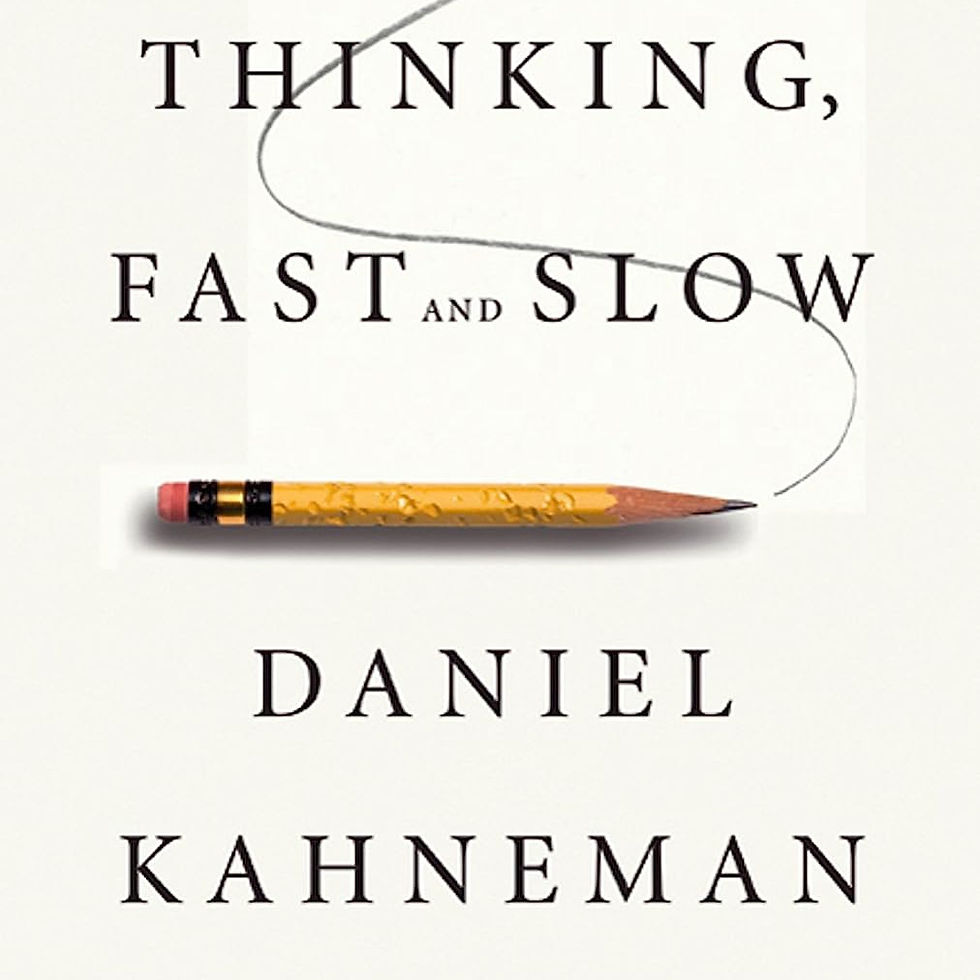
Sometimes, of course, thinking fast is useful. But, as Daniel Kahneman demonstrated, it can also easily lead us astray.
A surprisingly large number of speakers at the summit pointed to the disappearance of this cognitive effort as one of the risks associated with artificial intelligence.
AI gives us access to an engine that dramatically accelerates the process of reaching a conclusion. But acceleration can contribute to "de-skilling" or even “no-skilling.”
If you are learning something new while relying heavily on AI, you may reach the answer without ever developing the skills that the learning process was supposed to create.
This happens with every tool we use to replace one of our skills.
At my first job, every new joiner received an accounting calculator. It was very nice: large, convenient and easy to use. It took many of us no more than a year to lose much of our ability to do basic mental arithmetic. The tool worked perfectly and that was precisely the problem.
There is value in slowing down. We do not necessarily lose by making an effort; quite often, the effort is where the learning happens. Using tools to improve cognitive effort rather than eliminate it may therefore be one of the keys to avoiding their negative consequences. And this challenge did not begin with AI.
There was also a wonderful irony in the conference programme. Prof. Freeman spoke directly after a presentation by ElevenLabs, one of the pioneers of voice-focused AI. Their presentation was full of emotion and even tears.
Every moon has its dark side. 🙂
I publish one short reflection like this each week.
If you would like to follow these ideas, you can subscribe here
References and Notes
Kahneman, D. (2011). Thinking, fast and slow. Farrar, Straus and Giroux.
Thaler, R. H., & Sunstein, C. R. (2021). Nudge: The final edition. Penguin.

Comments