#121 - Personal Overshoot Day

Recently I did an interesting exercise with a group of my students. Using the Global Footprint Network calculator, we estimated our personal use of ecological resources and discussed the results together. I think the outcome was shocking for everyone in the room.
The results are presented either as the number of Earths required to sustain your lifestyle, or as your personal “Overshoot Day” — the date in the calendar when you have theoretically used your share of the planet’s yearly resources. The lowest result in our group was 3.2 Earths. The highest exceeded 6.
My own result was 3.7 Earths. In other words, if everyone on the planet lived like me, humanity would need nearly four Earths to sustain itself. My personal Overshoot Day fell on April 9th.
These numbers become even more striking when compared with global averages. According to the Global Footprint Network, humanity as a whole currently uses resources at the equivalent of 1.7 Earths, and the Global Earth Overshoot Day in 2025 falls on July 24th.
The methodology behind these calculations is complex and not always easy to follow, but the overall conclusions are broadly consistent with many other scientific assessments.
For example, Gerten et al. estimated that the current global food system could provide a balanced diet within planetary boundaries for only around 3.4 billion people. Likewise, the UN Global Resources Outlook 2024 shows that high-income countries consume six times more materials per capita — and generate ten times greater climate impact — than low-income countries.
The patterns are difficult to ignore.
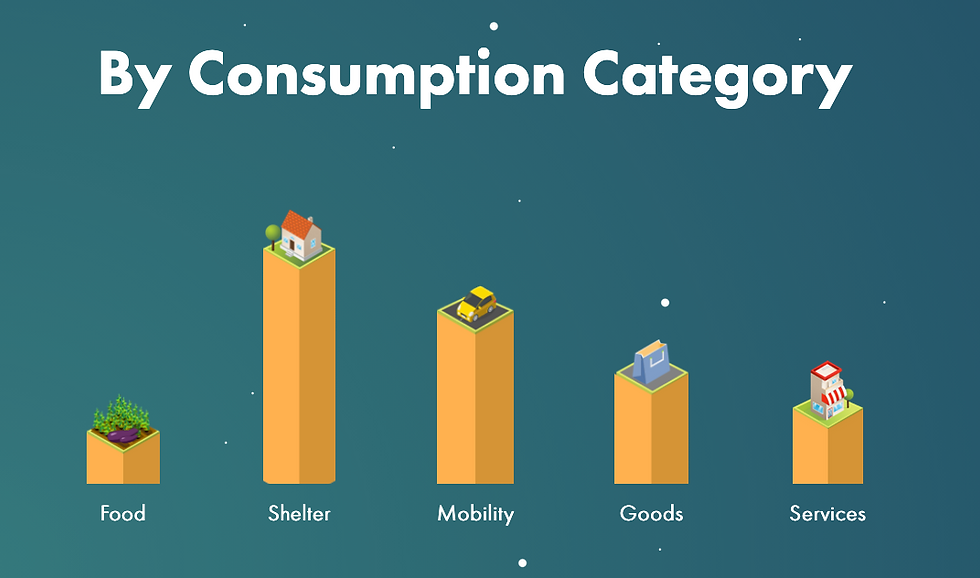
On the second picture I show the split of mu results by consumption category. As a vegetarian, I score relatively well in the food category. But that alone is nowhere near enough to make my lifestyle sustainable. Other categories are shaped not only by personal choices, but also by the systems we live within. Some questions in the calculator relate to the energy mix of the country, transportation infrastructure, urban planning, or the way buildings were constructed decades ago. These are not decisions individuals can easily change on their own.
I live in an apartment rather than a detached house. I try to limit car use and reduce unnecessary consumption. Yet I still end up classified as a heavy consumer of resources.
That realization may be the most uncomfortable part of the exercise.
We often frame sustainability as a matter of personal responsibility: recycle more, drive less, eat differently. These choices matter, but they operate within larger economic and technological systems that strongly shape our environmental footprint. Ultimately, we are products of the societies we live in, and individual action can only go so far without broader structural change.


So the key question becomes: what can realistically bring humanity back within planetary limits?
According to the Global Footprint Network, 1972 was the last year in which humanity lived within Earth’s annual regenerative capacity. At that time, however, the global population was 3.7 billion people — less than half of today’s 8.2 billion — and material consumption per person was significantly lower. Today we consume roughly 50% more materials per capita than we did then.
The challenge is therefore not only technological, but also civilizational.
Global Footprint Network echoes most of the widely discussed solutions:
Food systems are one obvious area. Reducing food waste, addressing overconsumption, and shifting toward more plant-based diets could substantially lower environmental pressure.
Urban development is another. With around 80% of the global population expected to live in cities by 2050, efficient public transportation, dense urban planning, and energy-efficient housing will become increasingly important.
Renewable energy is equally essential, not only for decarbonization but also for geopolitical stability and energy independence in an increasingly unstable world.
They also bring however a point, which remains surprisingly absent from mainstream discussions: population size.
Contrary to the widely discussed fears about alleged demographic crisis, they propose smaller families and population reduction as the key element of the sustainable world.
The idea is politically and emotionally sensitive, yet difficult to avoid entirely in any long-term conversation about sustainability. While public debate often focuses on fears of demographic decline, many countries have already entered a period of falling birth rates. I discussed this in a few other posts and I can not agree more. Population started to decline in all but one OECD countries, China and India are also below replacement level fertility, sooner than later all other countries will join. At least statistics suggest this is an inevitable trend, very unlikely to change.
From an ecological perspective, this trend may not necessarily be catastrophic. Modern economies often view population growth as essential for maintaining pension systems, labor markets, and economic expansion. But ecological systems operate according to different rules. We keep discussing this but what if nature already outsmarted us? Perhaps newer generations are adapting intuitively to ecological and economic realities.
You can listen in the short video below about some benefits of the population decline. Very fresh reflection on the matter, rejected by advocates of never ending growth.
The exercise with my students left me with an uncomfortable conclusion: even relatively environmentally conscious lifestyles remain far from sustainable within the systems we currently inhabit. That should probably concern us more than it does.
I publish one short reflection like this each week. If you would like to receive them by email, you can sign up to the newsletter here
References and Notes
Gerten, D., Heck, V., Jägermeyr, J., Bodirsky, B. L., Fetzer, I., Jalava, M., ... & Schellnhuber, H. J. (2020). Feeding ten billion people is possible within four terrestrial planetary boundaries. Nature Sustainability, 3(3), 200-208.
United Nations Environment Programme (2024): Global Resources Outlook 2024


Comments